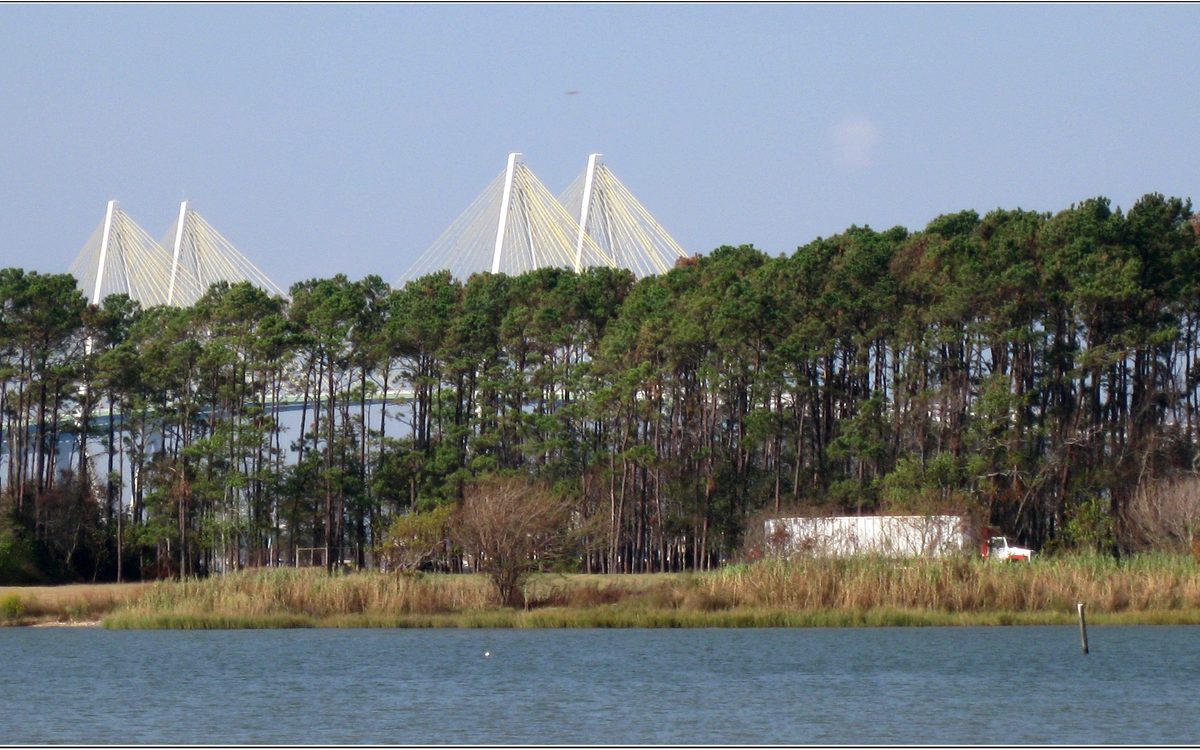
Early February here is the soft, in-between week. The pansies in the beds along Garth Road are still going. The mowers have been quiet since before Thanksgiving and nobody misses them. Somewhere up north a man in a top hat pulls a groundhog out of a box, and the television tells us whether there will be six more weeks of a winter we mostly don't get. On the bay the water lies flat and gray, and the pelicans sit on the pilings off Bayland Park like they are waiting on a bus. You wear a jacket to the truck in the morning and carry it back in your hand by noon.
It is the week to think about the freeze. Not because anyone wants to. Because this is the part of the year when it came.
In February of 2021 a cold front came down out of the plains the way they do, except this one did not move on. It sat. The temperature went below freezing and stayed there for days, which happens here about as often as snow on the beach. Pipes that had never been wrapped, because nobody thought they needed to be, froze and split. Water is one of the few things on earth that grows when it freezes, by about a tenth of its volume, and a copper pipe in an attic has nowhere to put that tenth. And then, in the small hours of a Monday morning, across most of the state, the lights went out and did not come back.
You remember where you were. Everyone does. The house went dark and quiet, and the first thing you noticed was the sound of nothing: no refrigerator hum, no furnace fan, no little green light on the coffee maker. Then the cold came in through the walls the way water comes into a boat. By the second day people were sleeping in their cars in the driveway with the engine running for the heater. By the third day the question in a lot of towns was not when the power would come back but whether the water would.
A town like this one had something particular to sit with in the dark. Baytown makes energy. That is what it is for. The refinery on the channel has been turning crude into fuel since Humble Oil began building it in 1919 and started it up in 1920. Up the road in Mont Belvieu, the salt caverns hold more natural gas liquids than anywhere else in the country. The tank farms go on for miles. If you drew a map of where the fuel in this state comes from, this corner of the bay would be one of the darkest ink spots on it. And we sat in the cold like everybody else.
That is not a complaint. It is a lesson, and it took a while to learn what the lesson was.
Energy is the thing you only see by its absence. Nobody notices the grid. Nobody stands at the light switch and feels grateful. The whole point of the system, the reason a few thousand people here go through a gate every morning, is that you never have to think about it. A pipeline that works is invisible. A power plant that works is a hum you stop hearing after a week in the house. The measure of the entire enterprise is how completely it can be forgotten.
Then it stops, and you see all of it at once, the way you see a room when the lights go out and your eyes are still holding the shape of it.
What stopped, exactly, can be said plainly and without blame, because the blame has been argued elsewhere and this is not that kind of essay. The largest share of the electricity in Texas is made by burning natural gas. Gas comes out of wells, moves through pipes, gets compressed and dried and separated, and arrives at a power plant where it is burned to spin a turbine. Every step of that is a machine standing outdoors. In the freeze, machines standing outdoors froze. Wellheads iced. Water in gas lines turned solid. Instruments quit. Some power plants could not get gas because the gas system needed electricity to run its own pumps, and the electricity was not there because the power plants could not get gas.
A grid has a heartbeat, and in this country it is sixty beats a second. Every generator on the grid turns in step with every other one, like a rowing crew, and the rate they turn is the rate the whole state's clocks and motors and lamps have agreed on. When the load on the grid outruns what the generators can supply, they do not fail one at a time. They all slow down together, a little, the way a crew slows when one rower quits. Slow down far enough and the plants that are still running begin to trip themselves off the line to keep from tearing themselves apart, and each one that leaves makes it worse for the ones that stay. That is the collapse the operators fear, the one that takes weeks to bring back, because you cannot restart a big plant without power from somewhere else. In the small hours of that Monday the beat dropped and stayed low for a few minutes, close to the line where the tripping starts. The grid operator, watching that number, ordered the outages on purpose. That part is true and rarely said out loud: the dark was chosen, to prevent a worse dark.
Understand what that means for a place like this. The plants along the channel are not separate from the grid. They are built into it. They draw power from it and, in some cases, make their own and put it back. When the grid buckled, units up and down the ship channel went into shutdown, some by choice and some not. Anyone who lives here knows what a shutdown looks like from the outside, because you can see it from your kitchen window: the flares go up, tall and orange and loud, burning off what cannot safely be kept in the pipes. For a few days that week the sky over the channel was lit from below while the houses under it were dark. People took pictures. It was a strange thing to see, the town's whole purpose burning off into the night and none of it coming down the wire. The flare across the water was, for that week, the one light in town that never went out.
There is a night-shift operator on a tower in every one of these essays, and he is always a composite, never one man. Ask him about that week and he will not give you facts. He will give you the feeling. The control room felt like the bridge of a ship in a storm. Everything you could do, you did, and then you stood there and watched numbers you could not change. The hardest part was going home, when he could, to a house with no heat and a family under every blanket they owned, and thinking: I make this. I make this all day, every day. And I cannot get any of it into my own living room.
We are a town that makes energy, and we learned that week that we do not own it.
Nobody owns it. That is what the freeze said, in the plainest language it had. The fuel in the drum on the channel is not yours until it has passed through fifty other hands and a thousand miles of pipe and wire, and every one of those hands and every mile of that pipe is a place where it can stop. A refinery is not a well, and a well is not a power plant, and a power plant is not the transformer on the pole behind your house. You depend on all of it. You depend on it the way you depend on your own blood, which is to say completely and without noticing, until something goes wrong with it.
There is an old idea in physics, and it is one of the truest things anyone has ever written down, that energy is never made and never destroyed. It only changes form. The heat that comes out of a furnace was in the gas before the gas was lit, held in the bonds between its atoms; the gas had it from the small dead things it was cooked out of, under a few thousand feet of rock, over more time than the word "old" can hold; and the burning only lets it out in a different shape, as heat, and the heat spins a turbine, and the turbine pushes electrons down a wire, and the wire warms a coil in a space heater in a bedroom in Baytown. Nothing in that chain is created. All of it is handed along. What the freeze taught, in the one week it had our full attention, was that the handing-along is the fragile part. The energy was there. It was in the ground, in the caverns, in the tanks. What failed was the passing of it from hand to hand.
And so the town, quietly, without a press release, learned to be a little more careful about the hands. People wrapped their pipes. People bought generators and then learned that a generator is just a smaller grid with all the same problems, a machine standing outdoors that needs fuel from somewhere. People who had never given a thought to how their house was heated found out, and some of them changed it. The plants, for their part, did what plants do after something goes wrong, which is write it all down and go through it line by line, and insulate what should have been insulated, and put heat on lines nobody thought would ever see ice. You cannot see any of that from the road. It is the invisible kind of work, the kind that only shows when it is missing. Which is to say it is the same kind of work as everything else here.
I think about the groundhog, actually. It is a silly ritual and everyone knows it is silly. But there is something in it. A whole country stopping for one morning to ask whether the cold will last. In a place with real winters that question is a joke. In a place like this, where a jacket is a thing you carry, it was, for one week, the only question there was.
The pansies made it, by the way. Some of them. The ones on the south side of the building, where the brick held a little of the day's heat through the night. You could walk down Texas Avenue afterward and see which walls had been warm and which had not, written in what lived and what didn't. Small thermal maps, purple and brown, at the foot of the brick.