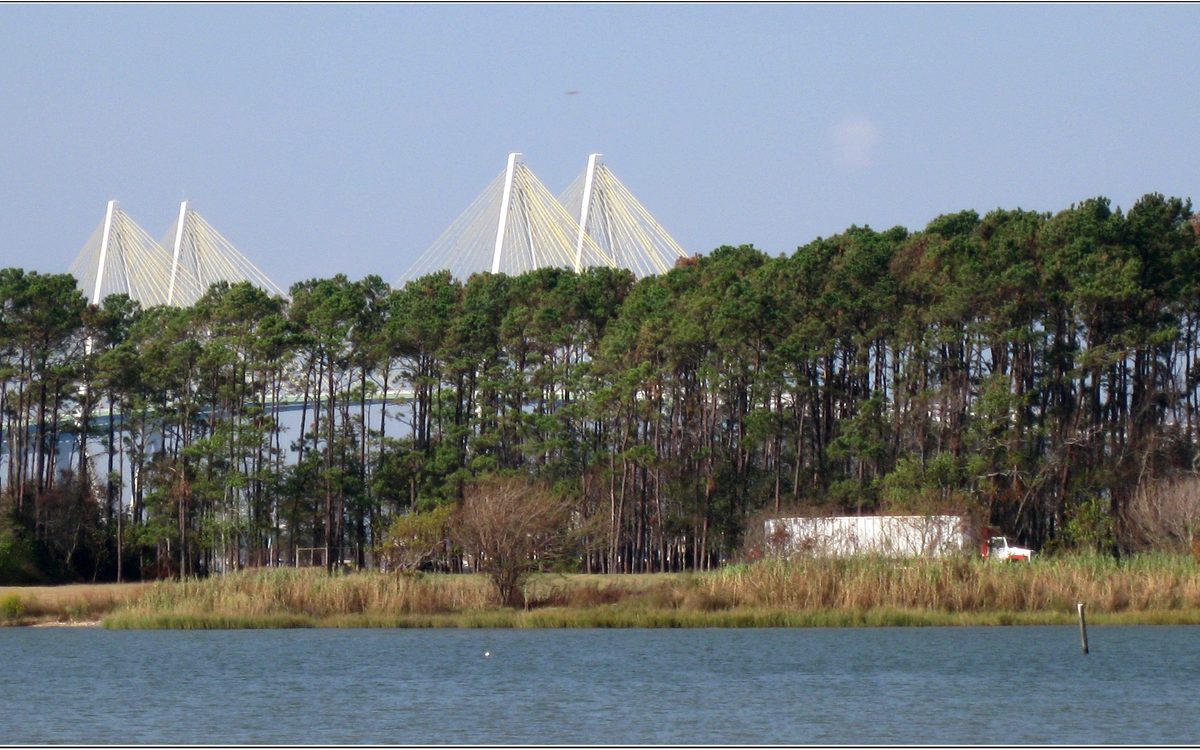
On the first of June nothing happens. The day hurricane season opens, the bay looks exactly as it did on the last day of May, flat and brown-green under a white sky, the pier at Bayland Park sticking out into it with two men fishing off the end and a pelican on the rail. The weather people say the season has started. The water does not seem to have heard.
But somewhere in a kitchen in town someone is doing the thing they do on the first of June. Counting the cases of water in the garage. Checking the generator, or checking whether the generator would start if they had one. Filling the tank in the truck. Looking at the hurricane tracking map that came free with the newspaper or the utility bill and pinning it on the refrigerator over the old one. It is a small ritual, ten minutes long, and it is done without much thought, and I have come to think it is one of the most serious things people here do.
Six months. June through November, with the worst of it in late August and September, when the Gulf has spent all summer soaking up sun and is as warm as bathwater to a depth that matters. A hurricane is a heat engine. It runs on warm water. The air over the Gulf picks up moisture, rises, and gives back the heat when the water vapor turns into cloud, and that heat drives more rising, which pulls in more air along the surface, which picks up more moisture. Given a few days and nothing to stop it, the engine tightens, spins, and walks. The depth matters because a storm churns the sea under it as it goes, and if the warm water is only a thin skin over cold, the storm brings the cold up and starves itself. Late in the summer the warm layer in the Gulf goes down far enough that there is nothing to bring up. The engine goes where the winds aloft steer it. Sometimes that is here.
Baytown does not sit on the open Gulf. It sits at the upper end of Galveston Bay, tucked in behind Galveston Island and the Bolivar Peninsula, at the top of a body of water that is, for the most part, very shallow. People who do not live here might think that is protection. In some ways it is — the big waves break on the outer beaches. But shallow water has a memory of its own, and what it remembers is surge.
Storm surge is not a wave. It is the sea itself being lifted and pushed. Under the low pressure at the center of a hurricane the water bulges up a little, like the surface of a drink rising in a straw when you pull on it. That part is small. The big part is the wind. A hurricane's winds, blowing for hours across miles of open water, shove the surface of the sea ahead of them, and when that moving water meets a coast it has nowhere to go but up and in. On a steep coast with deep water offshore the surge stays modest, because the pushed water can sink and spread. On a shallow coast the pushed water cannot go down. It piles. And a bay, narrowing toward its head, is a funnel: water forced in at the mouth has less and less room the farther it goes, and it rises to make up the difference.
Baytown is at the head of Galveston Bay. There is no arguing with the geometry and no moving it. It was true long before there was a town here and it will be true after.
The bay remembers 1900, when the storm that destroyed Galveston came across the island and killed more people than any other natural disaster in the country's history. The bay remembers 1983, when Alicia came in over the bay and finished the Brownwood subdivision — a neighborhood that had already been sinking for years as groundwater was pumped from beneath it, flooding a little worse each time, until the surge went through the houses and the town decided to let it go. The land is the Nature Center now. You can walk on it, the trails and the ponds, and here and there the path is said to follow what was once a street, so that you are walking where somebody's driveway was.
The bay remembers September 2008, when Ike came up the coast and pushed the water into the upper bay in the dark, and the sun came up on a shoreline that had moved. And August 2017, when Harvey did not come in as surge at all but sat down over the region and rained — more than fifty inches at some gauges in the Houston area, a number that had not been in anyone's plan — and the water came from the sky and from the bayous and from the rivers behind the town, all at once. Different storms, different water. The same bay took it all.
The bay's memory is the record itself. Every one of those storms is written into the shape of the shoreline, the height of the marsh, where the salt grass grows and where the trees died. The people who lived through them have their own memories, and those are sharper and shorter. A person remembers the sound of the wind, the smell of the house afterward, the night without power when the whole street sat outside because it was cooler out there. A person remembers the neighbor with the boat. A person remembers what they lost. But a person's memory fades in a decade or two, and the town's memory fades a little faster than that as people move in who were not here for it. The bay does not forget anything. It just waits.
That is why I think the ten-minute ritual on the first of June is serious. It is a way of matching your memory to the bay's. It is saying: I know where I live. I know what the water can do and I know it has done it. A case of water in the garage, a full tank, a plan for where the family goes and what they take — that is respect, not fear. You would not walk up to an animal that size without knowing what it was. You would not live beside one and pretend it was a pond.
The plants on the channel know this better than anyone, because they have to. A refinery cannot be evacuated the way a house can. Shutting a unit down safely takes time and is done in stages — the feed cut back, the heat taken off, the pressure let down, the lines cleared — and starting it back up takes longer than shutting it down did. The people who run those plants watch the same forecast the rest of us do and make their decisions days out, before the town does, because they have to be finished when the wind arrives. The night-shift operator on the tower has a view of the bay the rest of us do not get, and I have heard it said that from up there, before a storm, the water looks wrong first — the color changes, the swell comes in from the wrong direction, the birds go quiet — long before the first band of rain. I cannot verify that. I believe it.
What the town has learned, storm by storm, is written in things you can see if you know to look. Houses on the low streets rebuilt up on piers, their living rooms lifted a story into the air. Roads raised. The way a neighborhood simply stopped being a neighborhood and became marsh, on purpose, with a walking trail through it. The way people talk about Ike and Harvey by their first names, like relatives who visited once and left a mark on the house. The way the plywood at the hardware store sells out the afternoon the cone shifts west. None of that is in a manual. It is a town's memory doing its best to be as long as the bay's.
And the bay, for its part, gives back most of the year. It gives the sea breeze in the afternoon that makes August survivable. It gives the fishing off the pier and the pelicans on the rail. It gives the ships their road in and out — the whole reason the town has work at all is that the channel was dug through this water and opened in 1914, so that oceangoing hulls could reach Houston. The town is on the bay because the bay is useful, and the bay is dangerous for the same reason it is useful: it is big, it is joined to the Gulf, and it does what the weather tells it to.
So: the first of June. The pier, the pelican, the two men fishing. The map on the refrigerator with the tracks of old storms drawn on it in pencil. The water flat and quiet and not looking like it has ever done anything to anyone. You stand at the end of the pier and you look south, past the bridge, past where the channel goes out of sight, toward Galveston and the Gulf beyond it, and you think: not today. Not this week. Probably not this season. But the bay is not answering that question. It is not a question the bay has ever answered. It is only lying there, warm, remembering.