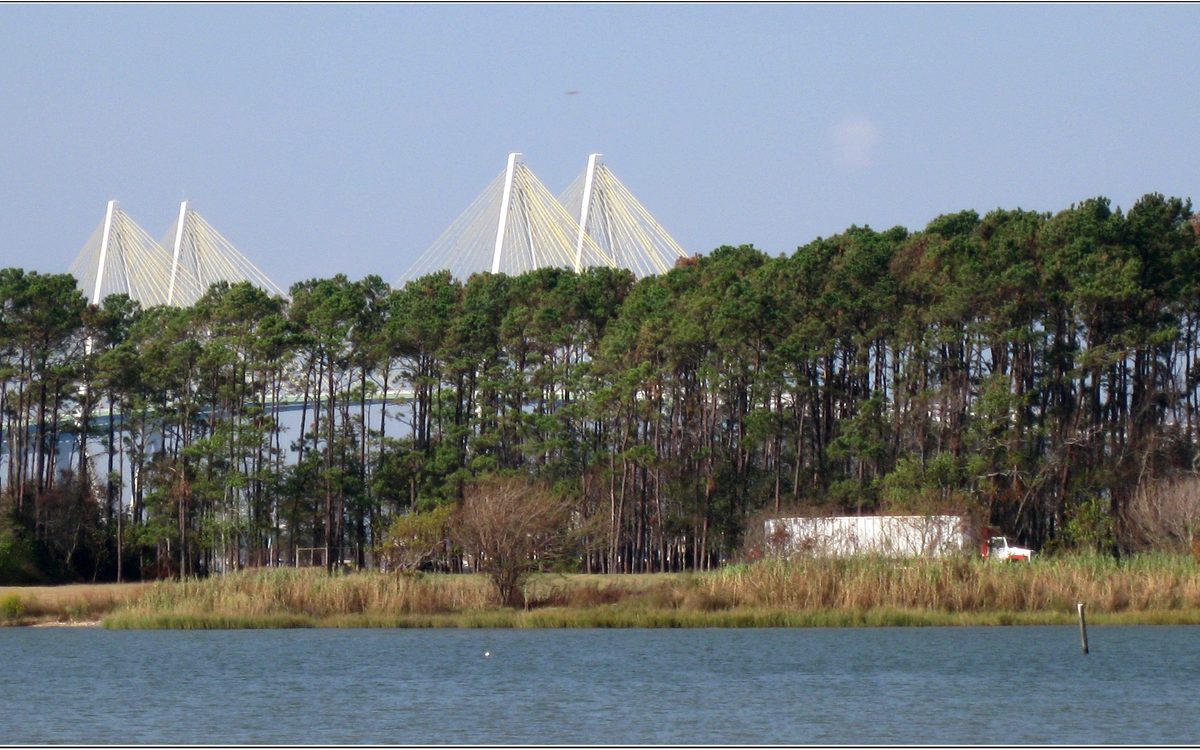
Birding Week, in November, is when the peninsula fills up. Not with people, though the Nature Center gets more of those too, standing in the parking lot with binoculars around their necks and a thermos between their feet. It fills up with birds. They come in over the bay in the dark, most of them, and by the time the gate opens they are already there, working the ponds and the salt flats and the drowned lots where a subdivision used to be, as if they had booked ahead. Birding Week is the town's way of noticing. It is a good week to walk the trails slowly, pay the small admission, leave the dog in the truck, and watch the sky do something it has done for longer than there has been a Baytown to watch it from.
You do not need to know the names. The names help, and the people in the parking lot will give them to you if you ask, but what you are looking at is not a list of species so much as an arrival. A bird that was somewhere far to the north a few weeks ago is now standing in a pond on the edge of the ship channel, and the only reason it is there is that it flew. Nobody carried it. Nothing carried it but its own body, and the body carried itself on a fuel it made from summer.
A bird crossing the Gulf is running an engine, and in the ways that matter it is the same engine as the turbines and furnaces on the other side of the fence.
Start with the fuel. Before a long migration a bird eats, and it eats with a purpose that would look like illness in a person. It gains weight fast, and the weight it gains is fat. Some of the small ones will put on so much that they are close to double what they weighed in midsummer. They do this because fat is the densest fuel a body can carry. A gram of fat holds a little more than twice the energy of a gram of sugar or protein, and it holds it without water, which is what makes it light. A body stores sugar as glycogen, and every gram of glycogen drags about three grams of water along with it, so that the same energy, carried as sugar, weighs several times what it weighs as fat. A bird that stored its summer as sugar would be too heavy to lift off. A bird that stores it as fat is a tanker with wings.
Now look at what fat is. Chemically it is a long chain of carbon and hydrogen with a small oxygen-bearing head on one end. Strip the head off and what you have left is, near enough, a hydrocarbon. It is the same family of molecule as the kerosene in a jet engine and the gas in a furnace. Not the same molecule, but the same idea: carbon holding hydrogen, and energy stored in the holding. When the bird burns it, the chemistry is the chemistry of any fire. Carbon and hydrogen meet oxygen. Carbon dioxide and water come out, and heat, and the heat becomes work. The bird does it slowly, at body temperature, with enzymes instead of flame, but the ledger is the same. Fuel in, oxygen in, carbon dioxide and water out, motion in between.
A turbine on the channel does the same accounting faster. Gas goes in, air goes in, the mixture burns, the hot gas spins a shaft, and the shaft turns a compressor or a generator. What leaves the stack is mostly carbon dioxide and water vapor, which is why you can sometimes see a plume on a cold morning and not on a warm one; the water is condensing, the way your breath does. A bird over the Gulf is exhaling the same two things. It would be a strange comfort to a hummingbird, but it is true: the chemistry that moves it across five hundred miles of open water is the chemistry the town is built around.
Five hundred miles is about right. A ruby-throated hummingbird, which weighs less than a nickel, is generally understood to cross the Gulf of Mexico in one flight, from the coast down to the Yucatán, without landing, because there is nowhere to land. It cannot glide much. It has to beat its wings the whole way. It does this on fat it laid down in a few weeks of feeding, and when it arrives it is light and hungry and alive. The Nature Center is quietly built around that fact, whether or not the sign says so. The same water that the tankers cross with tugs and pilots and radar, the small birds cross on stored summer and instinct.
Not every bird takes the straight line. Some go around, hugging the Texas coast down into Mexico, trading distance for the chance to stop and refuel. Some go straight across at night when the air is cooler. The choice is written somewhere in the bird, and the birds that followed it badly are not here to be counted. What is standing in the pond in November is the result of a very long sorting.
The wing has its own physics. A wing works by pushing air down, and the air pushes back, and the pushing back is called lift. The faster a bird flies, the more lift it gets from the same wing, up to a point, and the more drag it pays for the speed. Every bird has a speed at which the trade is best, where it gets the most distance for each gram of fat, and the ones that migrate long distances fly close to that speed. It is the same calculation a ship's engineer makes on the channel. There is a speed at which a tanker burns the least fuel per mile, and it is not the top speed, and a good captain knows it. The bird does not know it. The bird just flies it.
The big birds, the geese and the ibises and the pelicans, do one more thing you can watch from the pier at Bayland Park on a clear evening. They fly in a line or a V, each one a little behind and to the side of the one in front. The bird ahead leaves a small rising swirl of air off its wingtip, and the bird behind rides it, and saves a little effort with each beat. Researchers who put instruments on ibises found the birds timing their wingbeats to catch that lift. Engineers know this as drafting, and the same principle is why trucks run close on the interstate and why cyclists ride in a bunch. The birds arrived at it first, by a few million years.
So the Nature Center, during Birding Week, is a place where you can see the whole idea of the town laid out without a single pipe. Energy is stored in a hydrocarbon. The hydrocarbon is carried a long way. It is burned with oxygen in a controlled way, and the burning becomes motion, and the motion gets something valuable from one place to another. In the plants that something is ethylene or gasoline or the plastic in the binoculars. In the sky it is a bird. The difference is scale and speed, and the difference is not small, but the principle does not care about scale.
There is one more likeness, and it is the one that stays with you. The peninsula the birds stand on is itself a story about energy and what it costs. Brownwood was a neighborhood. It sank because the ground under it was pumped, water in that case rather than oil, and the sinking let the bay in, and after Alicia in 1983 the town gave the land back. It did not choose to make a bird sanctuary. It made a mistake, and then it stopped making it, and the marsh came in on its own. The birds did not need an invitation. They needed the water to be there and the mud to be full of the small things they eat, and once it was, they came.
You can stand on one of the trails now, out where the streets still show under the grass if you know where to look, and see a white pelican settle onto a pond that used to be someone's backyard. Behind it, across the water, the towers of the complex are doing what they do, and at dusk the flare will come up orange against the same sky the birds came in through. The pelican is not making a statement about the flare. It is digesting. The flare, for its part, is burning off what has to be burned. Neither one is looking at the other, and both are spending a hydrocarbon.
Where the bird got its hydrocarbon is worth tracing, because it did not eat fat. It ate insects and berries and seeds, and the berries were sugar, and the insects had eaten leaves, and somewhere back along that short chain a plant took carbon dioxide out of the air and built it into something the bird could swallow. The bird's liver then did what a refinery does in reverse of its usual order: it took small molecules and stitched them into long chains, and packed the chains under the skin and around the gut. A bird in September is a small chemical plant running a synthesis. A bird in November has already burned most of what it made. The two summers, the bird's and the oil's, are not the same length by a factor I cannot picture, but the carbon in both was pulled out of the air by something green, and the ledger closes the same way when it burns.
The night-shift operator on the tower will tell you that the birds are the only thing he watches from up there that isn't on a gauge. He can see the bay, and in the fall he can see the lines of them coming in low across it just before the sky goes fully dark, headed for the peninsula. He does not know their names either. He does not need to. They are going somewhere, on fuel they made themselves, with no chart and no radio and no one on the ground to talk them in, and they know the way, and that is enough to make a person at the top of a tower, with every number he needs on a screen in front of him, feel briefly like a beginner.
Walk the loop at the Nature Center during Birding Week and go slowly. Watch a heron stand in the water so still that the water forgets it. Watch a flight of ducks turn all at once, as if the turn were one decision made by forty bodies. Then look up, past the trees, at the stacks and the vapor and the steady work of the place. Something over there is being taken apart and burned so that something else can move. The heron in front of you did the same thing to a minnow an hour ago.
At the end of the last trail the ground drops off into the bay, and in the late light you can see the water go from brown to silver to a kind of bruised blue as the sun goes behind the refinery. The birds settle. The ducks stop turning. A pelican folds itself into the shape of a rock and, with no idea what it is standing on, goes to sleep on top of a street.