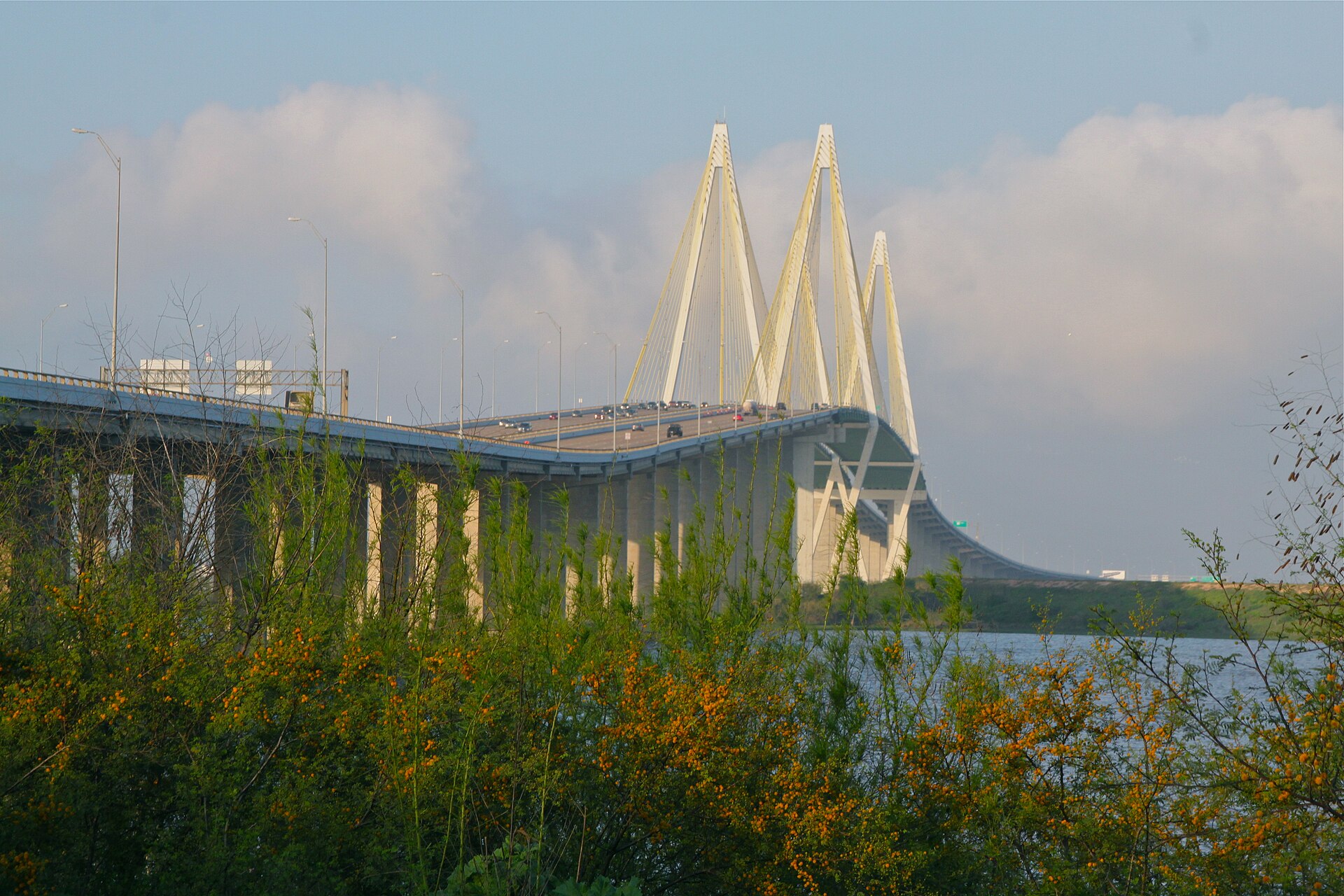
Mid-August, and the nights do not cool off. You drive back over the Fred Hartman Bridge after dark, up the long cable-stayed climb from La Porte, and at the top the whole east side of the county opens out below you lit like a city that is not there. There is no city. There are the plants, miles of them, every column and pipe rack and stair tower strung with lamps, the furnace stacks standing in their own glow, the tank farms dark and round between. From the top of the bridge on an August night Baytown does not look like a town that makes fuel. It looks like a town that makes light.
That is closer to the truth than it sounds, and I want to take it seriously, all the way down to the atoms, because what happens inside the brightest of those buildings is one of the strangest and most useful things people have ever learned to do, and almost nobody who lives in sight of it has had it described.
The building is an ethylene plant, what the industry calls a cracker, and the town has a large one. Its raw material is about as simple as a hydrocarbon gets: ethane, two carbons and six hydrogens, a gas that comes up out of the ground with natural gas and is separated out and, some of it, stored in the salt caverns under Mont Belvieu and piped down to the channel. Ethane is stable. It is content to be ethane. Left alone it would sit in a pipe for a thousand years. The cracker's whole purpose is to make it discontent.
It does this with fire. The ethane is mixed with steam and sent through a bundle of tubes hung inside a furnace the size of a church, and the furnace is fired from the floor and from the walls until the tubes glow and the gas inside them reaches something like eight hundred and fifty degrees Celsius, well past the melting point of aluminum. The steam does no chemistry of its own; it is there to thin the crowd, so that the ethane molecules are farther apart and less likely to find each other and stick, and to keep the inside of the tubes from furring up with carbon. At that temperature the molecule cannot hold itself together. What happens next happens in a chain. A few molecules break clean in two at the carbon-carbon bond, and the halves, hungry for an electron, tear a hydrogen off the nearest whole ethane. The ethane that lost a hydrogen is now unstable in its own turn, and it settles the matter by shedding a second hydrogen and doubling the bond between its carbons, and the hydrogen it shed goes off to tear one from the next molecule. So it runs, a fraction of a second, less than the time it takes you to blink, through the whole bundle of tubes. Add it all up and the ledger is simple. Ethane has become ethylene and hydrogen. C2H6 has become C2H4 and H2. Nothing has been created and nothing destroyed. Eight atoms went in and eight atoms came out. They are only arranged differently, and the difference is the whole modern world.
Then, immediately, the gas is cooled, slammed down in temperature in a set of exchangers just past the furnace, because at eight hundred and fifty degrees the reaction will not stop where you want it. Left another half second the molecules keep breaking, into methane, into acetylene, into soot. The art of a cracker is not the heat. Anyone can make heat. The art is the timing: exactly this hot, for exactly this long, and then stop. And even done right, a little carbon lays itself down inside the tubes every hour, so that every few weeks a furnace has to be taken off feed and burned clean with steam and air before it goes back to work. The night-shift operator watching the furnace readings is doing something closer to what a cook does at a hot stove than to what most people picture when they hear the word refinery. He is watching for the moment.
What comes out of the furnace is a mess, and honestly named: cracked gas. It is ethylene and hydrogen and unconverted ethane and methane and propylene and a dozen other things. The rest of the plant, the tall columns you see from the bridge, is a sorting machine. The gas is compressed, scrubbed, dried, and then chilled, in stages, colder and colder, until the components turn to liquid one at a time and can be drawn off, each at its own temperature, the way frost forms on a windowpane before ice does. The hydrogen and the methane, the lightest and hardest to catch, are taken off first, at the cold end of the plant, a hundred degrees below zero Celsius and colder. Ethylene is split from ethane further along, in a column that is still far below any winter the bay has seen, but not so deep in the cold. The ethane goes back to the furnace to try again. The hydrogen goes off to be used elsewhere. The ethylene goes out by pipeline, a clear gas under pressure, to the next plant, or the next, on the channel or up the road or across the state.
So the furnace is the fire, and the columns are the cold, and between them the plant runs a temperature swing that nothing else in the county comes near, from the heat of a glowing furnace tube to colder than any winter that has ever touched the bay, all inside steel, all so that two hydrogens can be persuaded to leave.
Now follow the ethylene out the gate.
Most of it goes to be made into polyethylene, which is what you get when you convince ethylene molecules to join hands in a line, each one opening its double bond to grab the next, thousands of them, until you have a chain long enough to be a solid. That is the grocery bag. That is the milk jug, the shampoo bottle, the water pipe under the street, the film over the leftovers, the lid on the cup, the coating inside the carton. Some goes to be made into ethylene oxide and then ethylene glycol, which is the antifreeze in your radiator and also one of the two building blocks of the polyester in your shirt and the plastic in the water bottle in your hand. Some goes, by way of chlorine, into PVC, which is the pipe and the siding and the insulation on the wire in the wall. Some becomes styrene and then polystyrene, the foam cup and the packing around the television. Ethylene is the most-produced organic chemical on earth, and it is that because it is the most useful starting point ever found: two carbons with a bond that wants to open. Look around the room you are sitting in and try to find something that did not, at some point, pass through a double bond like that. The screen you are reading on did.
That is the industry story, and it is a true one, but it is not the one I came up the bridge for. The one I came for is about the light.
Where is the energy in any of this? Not in the atoms. A carbon atom in a grocery bag is the same carbon atom it was in the furnace and the same it was in the ground, and it will be the same in whatever comes after. The energy is in the bonds, in the arrangement, in how tightly and in what pattern the atoms are holding on to one another. Pulling two hydrogens off an ethane molecule costs energy; the furnace pays it, by burning fuel gas under the tubes. Some of what the furnace pays is kept, for a while, in the double bond, which is a more restless thing than the single bond it replaced, and that restlessness is the entire reason ethylene is worth making. The rest of what the furnace pays leaks. It leaks as heat off the stacks, as the glow at the furnace throat, as the steam plume, and, after a long detour through a turbine and a wire, as the lamps on every column and stair tower you can see from the bridge. The light is the leak. What you are looking at from the top of the climb is the part of the energy that got away, and it is the smaller part, and the plant would rather it were smaller still.
The part that does not get away is the product. At the next plant down the pipeline the restless bond does what it was made to do: it opens, grabs the next molecule, and closes into a chain, and in closing it gives back a share of what the furnace paid, as heat, which that plant has to carry off in its own cooling towers. What stays in the polyethylene is the ordinary energy of carbon and hydrogen holding on to one another, the same energy that was in the ethane in the ground, now arranged in a line ten thousand atoms long instead of a molecule of eight. The arrangement is the product. It is what makes the bag strong enough to carry the milk, and the pipe under the street able to hold its shape for a century. A polyester shirt is the same energy in a different pattern. When any of it is finally burned or buried or breaks down, the pattern comes apart and the energy leaves the rest of the way, as heat, as a little light, and the atoms go back into the air and the ground with nothing lost but the order.
That is what a town like this does, stripped of every slogan for and against it. It spends energy to rearrange atoms into patterns that are useful, and keeps as much of the spending inside the pattern as it can, and lets the rest go as light over the bay. A town that makes fuel is a coarse description. A town that takes things apart and puts them back together in a more useful order, at a cost, and shows the cost on the skyline every night, is closer. The glow you see from the bridge is the receipt.
There is one more turn in this, and it is the one that makes the whole thing worth a night on the bridge. Ethylene, the molecule the furnace makes, is not an industrial invention. It is a hormone. Plants make it, in tiny amounts, and use it to tell a fruit to ripen and a leaf to let go in the fall and a flower to open. A peach in a bowl on a kitchen table in Baytown is making the same molecule the plant across town is making, two carbons and four hydrogens, identical to the last electron, and using it to turn itself sweet. The tree does it in the dark, with enzymes, at room temperature, one molecule at a time. The plant does it with fire, by the ton. Neither of them invented it. The molecule was there in the chemistry of carbon before there were trees or towns, waiting to be found from both directions, and it was.
A young operator on the night shift at an ethylene plant, looking at a furnace outlet temperature on a screen, is a collection of atoms that were themselves made in stars, using the energy in one set of bonds to break another, so that other collections of atoms can drink from a bottle or drive on a tire or lie under a hospital blanket. The universe, at that desk, is rearranging itself with a coffee in one hand. It does not feel grand. It feels like Tuesday.
The bridge descends. The light falls away behind you into the mirror of the bay, and the flare is small, and the furnaces glow orange at their throats, and a night shift is at work in there watching for the moment. At the bottom of the bridge you turn toward home, and for a mile or two the plant is in the rearview mirror, a city that is not there, every lamp on it a little of what the furnace could not keep.